


.svg)
.svg)
.svg)
.svg)
In every global challenge, there lies an opportunity to innovate. Over the years, practices once considered normal, like smoking on airplanes or throwing everything in the trash, have changed for the better. As we’ve grown wiser, we’ve made massive strides toward protecting our health, preserving our planet, and rethinking how we use limited resources.
So why, in an age of innovation, do we still treat waste as a worthless burden?
Find out how Harvest Nano, a company led by practical scientist and PhD Dr. Aharon, found the solution to our global waste crisis by turning waste into renewable materials. It’s a solution that doesn’t just manage waste- it reimagines it, transforming what we discard into something valuable, scalable, and urgently needed. We call it waste mining.
Most of us are aware of the world’s overconsumption problem. From fast fashion factories discarding unsold inventory- like the massive clothing dump in Chile’s Atacama Desert that’s now visible from space (Lea, 2023; Scholastic, 2023)- to data centers and AI warehouses using enormous amounts of water and energy, waste is everywhere. There is a real need for waste-to-resource technology.
According to The Story of Stuff, 99% of the stuff we harvest, mine, process and transport is discarded within 6 months. In the U.S., this cycle happens on an industrial scale.
Engineers are trained to optimize manufacturing while treating waste as an afterthought that needs to be eliminated. The result is often contaminated water, overflowing landfills and environmental hazards in our own neighborhoods. Animal agriculture adds another layer- , millions of pounds of milk, poultry and beef result in waste that contributes to pollution and health risks. Recycling facilities struggle to separate plastics efficiently, relying heavily on manual labor that isn’t always effective. Even human waste is underutilized and underexplored when it comes to waste mining. These are all opportunities for valuable biodegradable nanomaterials.
But what if all this waste (organic, industrial, even human) could become a resource? What if it could power a new kind of circular economy innovation?
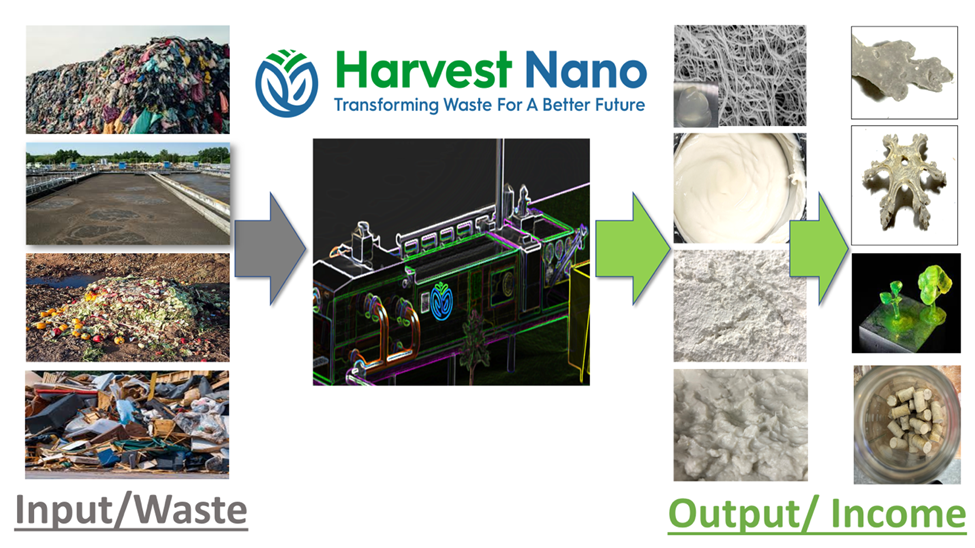
At Harvest Nano, we believe the answer lies in a groundbreaking material first discovered in the 1980s: Nanocellulose.
Nanocellulose is a biodegradable, non-toxic, abundant and carbon-reducing material derived mainly from plant fibers. When this sustainable manufacturing material is transformed to the nanoscale, it becomes a new material with superior properties. Nanocellulose is incredibly strong, approximately four times stronger than steel. This is a material that belongs to the future, and our patented machines make it accessible today.
With our proprietary technology, Harvest Nano’s turnkey systems are customized to produce micro and nanocellulose from variety of organic waste streams, producing renewable materials that can be used in packaging, automobiles, textiles, construction materials, furniture and more. The possibilities are endless. Learn more about our nanocellulose production systems here.
We believe this is the beginning of a new era in sustainable innovation- one driven by a decentralized, circular economy where waste becomes a tool for regeneration. We consider nanocellulose to be the “diamond” in the rough, the most valuable material extracted from our waste. .
We are not just engineers and scientists. We are architects of a larger waste-to-resource innovation, a movement to change how industries, governments and people think about waste. Just as past generations revolutionized sanitation, energy and transportation, we believe the next global leap forward will come from rethinking materials.
Harvest Nano invites communities and corporations alike to join a cleaner, smarter model- one where waste becomes a catalyst for sustainable change.
At Harvest Nano, we don’t just aim to reduce waste, we want to redefine how the world sees and uses it. By partnering with manufacturers, municipalities and private organizations, we design, install and operate our systems directly at the source of waste. We turn costly liabilities into valuable, renewable materials.
Let’s Harvest a better future. Follow us for more insights, updates and stories from the forefront of green tech. Interested in partnering with us? Get in touch here.
Click here to watch our two minute movie explaining more about our process.
Sources:
Leonard, A. (2007). The Story of Stuff [Video]. Free Range Studios. https://www.youtube.com/watch?v=9GorqroigqM
Lea, R. (2023, June 22). High fashion! Mountain of discarded clothes in Chilean desert is visible from space (satellite photo). Space.com. https://www.space.com/mountain-discarded-clothes-chile-satellite-photo?utm_
Scholastic. (2023, March 13). Fast fashion graveyard. Scholastic Science World. https://scienceworld.scholastic.com/issues/2023-24/112023/fast-fashion-graveyard.html?utm_=&language=english#1070L
Harvest Nano. (2025, March 5). Waste innovation by Harvest Nano [Video]. YouTube. https://www.youtube.com/watch?v=jQnhv5QKmcc
Teare, M. (2022, April 1). Dear Mr. Bin Man: Circular economy solutions for fashion | TEDxWarwick [Video]. YouTube. https://www.youtube.com/watch?v=heIXdS7Gs7c
.svg)